Guide · On-chain vs custodialUpdated 9 October 2026
Guide
 Guide
3tiers of casino
On-Chain vs Custodial Casinos: who holds the balance
 By Elias Varga
In a casino, the difference between on-chain and custodial lies in who holds your coins between a deposit and a cash-out. With custodial, a casino credits your balance in their system upon a deposit. In the case of on-chain, the deposit would be left in a contract, which is essentially a computer program that you can empty yourself and decide the bets with a number that anybody can check. None of the ten casinos reviewed here is the second type in the fullest sense. This guide delineates where each type draws the line and explains what each protection carries and what it leaves to trust.
- 0 of 10reviewed casinos fully on-chain
- 1balance held in a contract you can leave: Just.bet
Where it appliesOn-chain casino rankingThe ten scored on what settles on the chain.
On-chain casino ranking
The three tiers
- 10wallet sign-ins, all custodial
- 1escrow contract: Just.bet
- 4casinos with a form after the signature
Tier 1: non-custodial, on-chain
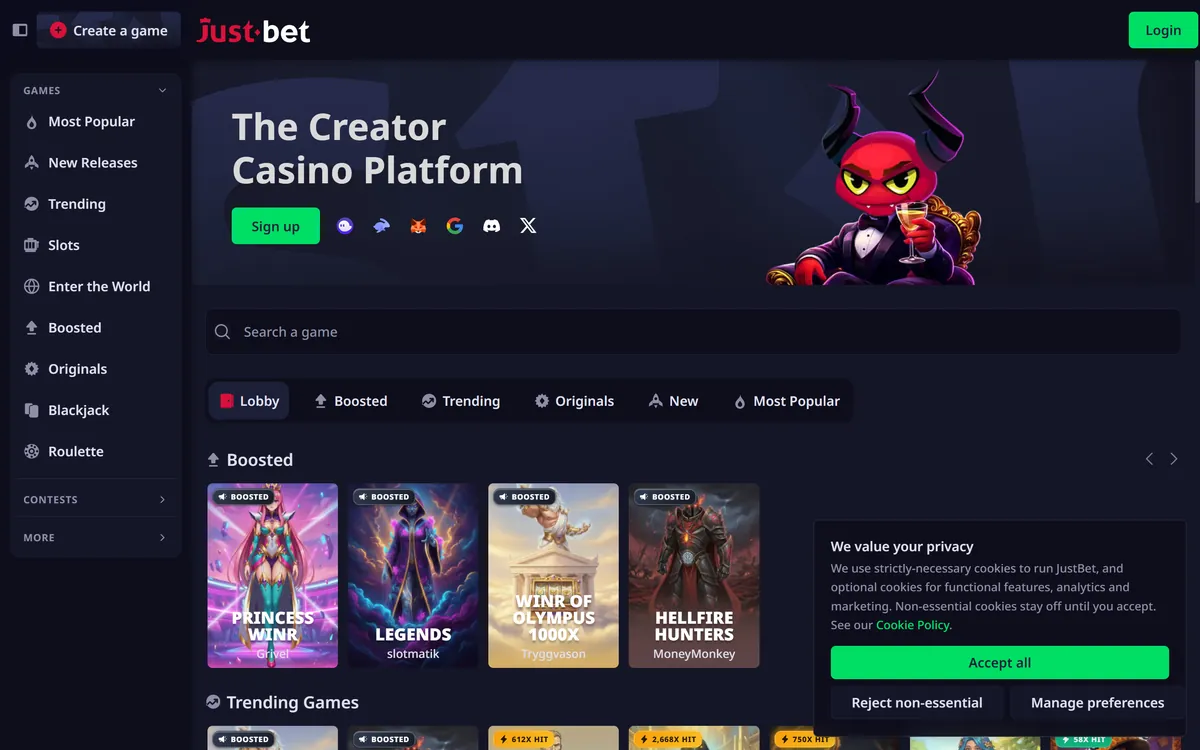
In this type, the settlement of a bet is by a smart contract and the coins are in your control until the settlement. No casino of the ten reviewed is of this type in the fullest sense. Just.bet, however, is the closest. Just.bet employs an escrow smart contract on Arbitrum that holds the balance and a release of the balance is by a Merkle proof. Terms and conditions of Just.bet state, however, that Just.bet is a hybrid casino.
Tier 2: wallet sign-in, custodial
To deposit to a casino balance, you are required to sign a message to log in. All of the ten reviewed casinos fall in this type. MetaMask is offered at all the ten reviewed casinos. Phantom is offered at three of the ten reviewed casinos, WalletConnect at five and a Privy dialog at Just.bet. In all of these, the deposit is to a casino balance, but the signature proves the wallet.
Tier 3: account required
To deposit to a casino balance, an account Email/password is required. This type is not employed at the doors of any of the ten reviewed casinos. Of the ten reviewed, Roobet, Bitcasino, Rollbit and Fairspin, follow the signature with a form. A button to Connect Wallet in the Cashier is a deposit method and never lifts a casino out of this Tier.
The wallet login ranking places the ten in order based on what the sign-in asks for, and the connect wallet guide describes the prompt itself.
The three tests an on-chain casino would pass
The balance sits in a contract. Just.bet passes. Deposits are USDC on Arbitrum and are locked in an escrow contract, the balance is WINR. Clause 5 of its terms states that since the funds are on-chain, you can get a Merkle proof and withdraw funds directly from the contract, even if the site is unavailable. The other nine credit a balance in their systems.
The outcome comes from a verifiable number. Metawin passes for its prize draws only. Per its review, entries sit in a smart contract, Ethereum draws use Chainlink’s VRF and Base draws use API3’s QRNG, and all other games are decided by a server.
The bankroll can be inspected. Just.bet is the only casino of the ten reviewed to say that the funds used to pay out winners is held by liquidity providers, rather than the house. A bankroll in a smart contract is a promise to pay the winner. A bankroll in a company’s account is a promise the company makes.
The on-chain ranking system bases its score on these three, and begins with the caveat that none of the ten passes in all three.
Where each of the ten holds a deposit
- 9company-held balances
- 1contract-held balance
- 2casinos with any on-chain randomness: Metawin's draws, none for games
| Casino | Where the deposit sits | Who decides a bet | Exit without the operator |
|---|---|---|---|
| Just.bet | USDC in an escrow contract on Arbitrum; the balance is WINR | Just.bet's servers, HMAC-SHA256 commit and reveal | Yes: a Merkle proof releases the balance last committed to the chain |
| Metawin | A casino balance; prize-draw entries in a smart contract | Servers for games; Chainlink VRF or API3 QRNG for the draws | No for the balance |
| BC.Game | A casino balance, credited on landing | Servers; 74 provably fair originals | No |
| BetFury | A casino balance | Servers; 24 provably fair originals | No |
| Bitcasino.io | A casino balance | Servers; provably fair originals with a verifier guide | No |
| Dexsport | A casino balance, credited from about $0.10 | Servers; studio games | No |
| Roobet | A casino balance; name and address form before the first deposit | Servers; 14 originals | No |
| Solcasino | A casino balance; USDB bonuses | Servers; originals and studio games | No |
| Rollbit | A casino balance | Servers; X-Roulette, X-Crash, futures outside the gaming licence | No |
| Fairspin | A casino balance; TFS rakeback tokens | Servers; studio games, the earlier chain record gone from the site | No |
Every casino's clause is quoted on its review.

What each design protects, and what it leaves to trust
A contract-held balance protects against
 A contract-held balance protects against
- A closure or an outage: the Merkle-proof exit works when the platform does not, by Just.bet's clause 5
- A frozen withdrawal queue: the contract pays the balance it last committed, without a support ticket
- An inspectable bankroll: the WINR contract and its liquidity providers are on Arbitrum
- A smaller trust surface: the question is whether the contract is written well, not whether the company is
It does not protect against
 It does not protect against
- A disputed bet: the outcome was decided off-chain and the exit pays the balance, not a correction
- A verification clause: clause 4 still allows identity checks before a withdrawal
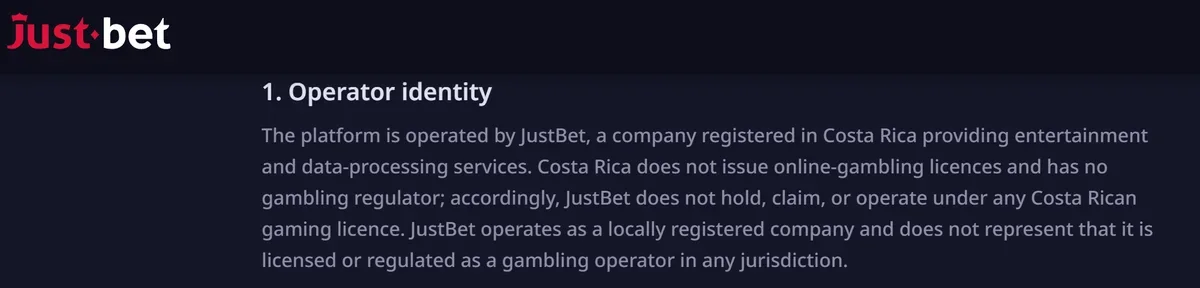
- A licence: clause 1 says there is none, and a contract gives no regulator to complain to
- A token's price: the balance is WINR, worth whatever WINR trades at when you cash out
Nine of the others depend on tested cash-outs, the terms and the license for the right-hand side. The left is largely unprotected. The withdrawal guide is that test, and the rug-pull guide is what happens without it.
Why on-chain is a product design, never a legal status
A smart contract does not remove an operator's need for a licence in a country that requires one. Just.bet, the one casino here with a contract-held balance, states in clause 1 of its terms that it holds no gaming licence and is not regulated as a gambling operator in any jurisdiction, and it names 27 countries it blocks.
Decentralised describes how the money is held and the bets are paid, nothing more. This site writes each licence as the casino states it, or NOT DISCLOSED, and gives no verdict on whether playing is legal where you live.
Is Web3 gambling legal? covers the licensing, the countries that each casino blocks, and what a regulator's register can and cannot disclose.
On-chain and custodial questions players ask
What is a custodial casino?

Nine of the ten have your balance held in their systems. You send coins to the address the cashier shows, the casino credits an account, and every bet moves numbers in the casino’s database. A withdrawal is the casino transferring coins to you. Whatever their login process is, the money is held by a different entity.
What is a non-custodial casino?
One where the money is held where you can reach it without the operator. The strict form of this means your coins are held in your wallet for the duration, and each bet is settled by a contract. Of the ten reviewed, only Just.Bet comes close. Just.Bet’s escrow contract on Arbitrum provides for a Merkle proof to withdraw your coins. Bets are still settled on Just.Bet’s server.
Is Just.bet non-custodial?
As for the balance, by its own definitions, with an escrow contract and a Merkle-proof exit. The results? Not on-chain. It is partly on-chain and operated off-chain and not fully decentralized. Fairness is HMAC-SHA256 commit-and-reveal, done on its servers. It has an account, can verify ID before a withdrawal (clause 4), and has no gaming license (clause 1). It is at tier 2 with escrow explained.
Can an on-chain casino still ask for ID?
Yes. Clause 4 of Just.bet allows them to verify your identity before certain actions, including withdrawals, and Clause 7 states the checks are self-regulated. A contract with your balance doesn't remove a verification clause; it only means the contract's own exit doesn't depend on a verification check. Every single review quotes the clause as it's written by the casino.
Is provably fair the same as on-chain?
No. Provably fair does not describe the location of the balance; it is completely server-side. True on-chain settlement means the balance, the random number, or both are put in a smart contract. BC.Game has 74 Originals which are provably fair and custodial; the prize draws at Metawin are determined by a contract and the casino balance is custodial. The Provably Fair Guide splits the two.
Is an embedded wallet custodial?
This site calls it an embedded wallet with service-held keys and never your own. Just.bet uses Privy to create a wallet with a key split and a share held in Privy’s secure enclave. Fairspin, Rollbit and Dexsport bundle Particle Network for their embedded wallets. The embedded wallets guide explains the key side.
Which is safer, on-chain or custodial?
For the money, a contract-held balance with a working exit narrows what a closure can take, and the rug pull guide illustrates with Luck.io’s returned vaults vs. ZKasino’s bridged ETH. For everything else, a license, a regulator, withdrawal rules and a cash out test, matter equally at either tier, and a poorly written contract is its own risk. A small balance is the safeguard at both tiers.
Does on-chain mean anonymous?
No. A public blockchain shows all deposits and withdrawals and verifications in reviews pertain to the account that holds the balance. This site writes no-KYC only as the casino’s own published policy and quotes its reservations. It gives no legality judgements for any country.
The ten casinos, each with its tier on its review
 Just.bet6.1
 Metawin7.0
 Dexsport7.6
 BC.Game7.4
 BetFury7.2
 Roobet6.9
 Bitcasino.io6.8
 Solcasino6.7
 Rollbit6.6
 Fairspin6.3
Keep reading
- RankingOn-chain casinosThe ten scored on what settles on the chain
- GuideProvably fair on-chainSeeds, hashes and random-number contracts
- GuideCrypto casino rug pullsWhat a company-held balance costs when the company goes
- Wallet guideEmbedded wallets explainedWhy a Privy wallet is not your own
- GuideWithdraw from a Web3 casinoThe cash-out at each tier
- GuideIs Web3 gambling legal?Why a contract changes nothing about a licence

About the author
Elias Varga writes CryptoReel from Lisbon. He keeps the login screenshot beside every tier claim, and writes no casino up a tier for a connect button in its cashier.
Play it safe
You must be 18 or over to gamble, and older where your country says so. Fund a separate wallet with what you can afford to lose, and treat a loss as the cost of the evening. If gambling stops feeling like a pastime, Gambling Therapy offers free help in many languages. Our responsible gambling page lists more services and the limit tools casinos offer.